Search This Blog

18 April 2020

The Covid-19 virus 2020 lockdown. What stays open?

Information for Countries, businesses and economists.

A special note for economists and the media. During the Covid-19 
lockdown, the economy does not 'stop'. Some sectors close down and.
other sectors of the economy continue!
Economists and the Media, love to use the words "re-start the economy".
It's false to say this.

The Tourism / Travel and Hospitality sector is the worst hit,
during and after the lockdown. Yes, some countries, rely only on tourism.
Other countries like France and Italy, have big production (food) and
manufacturing (engineering) sectors.

Note: After a 1 to 3 month 'lockdown' period, there is a 
6 month to 1 year or 2 year period of 'safety restrictions' in place.
People and businesses have to learn to survive and adapt.
Most businesses had to learn to be flexible.

What stays open during a lockdown?  Who keeps working?

The Economy is open.  (It's only 'slowed' down)
Many industries, factories, shops, etc. stay open and millions of
people go to work everyday. There are many essential industries, for example:

- All basic municipal services continue.
  (eg. Water, gas, sewerage, and waste removal services)
- All power stations / electricity companies open
- The Oil and Gas industry fully operational.
- The Mining industry open. (Copper/aluminum etc.)
- The glass and plastic industry (Coke/ Perrier bottles etc.)
- All petrol stations are open
- Ports and borders stay open for trade (goods)
- Airports run at 10-15%
- Trains and public buses run at 30%                                                        
- Private Taxi and Ambulance services work
- Hospitals, clinics and laboratories open.
- Police, fire departments and security companies.
- All postal agencies open
- Banks are open
- All pharmacies are open
- Pharmaceutical manufacturing industry
- The Alcohol/ wine industry
- Newspaper and tobacco agencies open.
- Media companies, Television and Radio stations.
- Telecom / Telephone companies open. 
- The Agriculture / Farming sector.
- All Agri equipment service/ repairs open
- All supermarkets/ food shops open.
- The Transport/ Logistics sector open
- The Tech/IT industry open
- The Timber and paper industry
- Garages/tyre repair shops 80% open
- Building/ Construction industry 30% 
- All veterinary staff work
- All Prison staff work
- The Lottery keeps going 
(Don't forget all the thousands of cleaning staff that work everyday)


Every country is different and Economists know exactly how many
people are employed in each sector.

NB: In a health 'pandemic' lockdown:
1st Line Workers =  All hospital, health care / medical staff.
2nd Line Workers = Farmers, agricultural workers, food/ beverage
manufacturers, Police and fire departments. transport, truck drivers, food retailers, pharmacies.

School and University students got their lessons via telephone, email
or Skype. (So, most teachers and professors still worked)


15 April 2020

The 2020 Covid-19 Virus outbreak in Europe and what we can learn.

Important information, during the Covid-19 virus outbreak in Europe.
March 2020 in France. Population 67 million.


This info can help other countries that are not as badly infected or affected yet.
Note: Experts predict more virus outbreaks in the future.
Countries have to be prepared and we can all learn alot from this crisis.

A 'health' lockdown or shutdown of a country, is a very serious matter.

- 1st the borders are closed to travelers and tourists. (Not closed for trade)
- Creches/ day care centers, closed, (open for 1st line workers children)
- All schools and Universities closed.
- Restaurants, bars, hotels closed.
- All non-essential business and shops close.(eg. toy shops, jewelry stores etc.)
- All concerts and sport events cancelled.
- All church / religious/ social gatherings stopped.
- All old age homes closed to visitors.
- All prisons closed to visitors.

The first weeks of a pandemic are chaotic, for hospitals and emergency services.
At the start, it's not very clear which businesses or services are essential
or not essential.
- People are unsure if they have a job or not.
- Some employers give staff, the option of 1 month's leave, etc.

Most countries have to call the Army, to help.

Next post: What stays open?


20 November 2016

Is 'Duty Free' at the airport really cheaper than a normal supermarket?


Other than Cigarettes, the question is, is 'Duty Free' really cheaper than a
normal supermarket?

My theory is that you can get wine cheaper at a supermarket than at 'Duty Free'.
Many 'Duty Free' shops have been exposed to be not much cheaper.

Please, let us know what you think..


Tourists visiting South Africa. What to buy and take back with you?


Indian Spice Market, Durban

For tourists coming to South Africa with Dollars, Pounds or Euro's,
take full advantage of the exchange rate.  It's in your favour.
Many things will be cheaper for you in South Africa, even Dental care.

Food and drinks in restaurants is 3 times cheaper.
Food and alcohol in supermarkets is 2/3 times cheaper.

-Cigarettes at a supermarket or at the 'Airport Duty Free' are much cheaper
  than in Europe.
-Gold and diamond jewelry. (A good investment)
-Buy the world famous Gold Krugerrands. 'A gift that keeps on growing.'

-African art and curios. (There are many African craft markets)
-The ostrich leather products (shoes, bags, wallets etc)
-Spices at an Indian spice market or in supermarkets.
-Witblits, Mampoer, Amarula Cream Liqueur and many other liqueurs.
-South Africa has some of the best Brandy's in the world.
-Supermarkets have great prices for bottles of South African wine.
-Dried fruit and nuts  (Guava roll's, etc.)
-Dried meat products. Eg: Biltong, dry sausage etc.
-Books, Music CD's, DVD's.
-All the Aloe products. (Great quality and cheaper than in Europe)
-All basic medication is cheaper, eg: Strepsils, headache, cold and flu tablets etc.


Fact: Music is cheaper.
One song on ITunes in South Africa costs around R9.30
 (0.70E)
ITunes in Europe is 1.20Euros for one song.
So, you are paying around R20.00 to buy one song in Europe!

Happy holidays!


South African Expats, what to buy in South Africa and bring back with you?


All the SA Expats, spending your hard earned money on trips up
and down, back and forth... to see family, etc.

Make your trips back home, count.
Buy and bring things back, which are cheaper.

Most people think that you earn 'BIG money' overseas. Ha. Ha.
So, you should all be returning as 'Dollar Millionaires'.
But, that's not really the case.

Fact: The average person in Europe does not really earn a lot.
Eg. average school teacher earns roughly 1.300 EUR p/m.
The 'middle class' in Europe is actually poor, many people are in debt and
don't have much savings. The cost of living is very high.
Don't forget, they pay a lot in EU charges, taxes, insurance, MOT, etc.

Fact: The cost of living in Paris is 100% more than in Johannesburg.
(www.expatistan.com, - The cost of living index, 2016.)

People in supermarkets in Europe also buy the 'no name' products to scrape by.
For example: Beef is very expensive and most people can only afford chicken
or pork.

Because of many high EU regulations and taxes, 1.00 Euro, can not buy
you a coffee in a café in Europe, now.


Bunny Chow. A real South African lunch for around 1.50euros.
A crepe with chicken and cheese in a restaurant in France, 8.50euros..
that's R150.00 for a pancake! 


Some examples: 20 Nov, 2017. - Regular Headache tablets
(only 8 tablets in a pack) in France is 2.20euros. Nov, 2017

A pack of 50x headache tablets (Grand-pa or Compral)
in South Africa is R45.00
A rough exchange conversion.. 1.00Euro is equal to 17.00 Rand.
This means...  8 tablets in France are R34.00   WOW!

Books and paper are very expensive in Europe.
Basic notepads / school exercise book cost around 3.00euros in a supermarket.
That's R50.00 for a 80 page paper notepad!
In South Africa you pay around R7.00 an school exercise book.

150g Tick & Flea Powder for dogs in France 8.50euros  = R120.00
150g Tick & flea Powder for dogs in South Africa R45.00

400g Peanut Butter (Smooth) in France 4.50EUR = R76.50
400g Peanut Butter (Smooth) in South Africa, is around R27.00

Yes, exchange rates, import duties, etc. are constantly changing.

Things to buy in South Africa and bring back with you:
-All basic Cold and Flu medication, is cheaper
-Tick & Flea powder for dogs
-Game Naartjie powder sachets (hard to find in Europe)
-Pro-vita Crackers (Not available in most countries in Europe)
-Peanut butter
-Chutney.
-Kiwi Shoe polish (Cheaper and bigger selection in SA.)
-Spices for food. (Larger selection of spices in SA.)
-Dried fruit and nuts (Guava rolls. etc)
-Books (Big book shops in SA have great specials)
-Paper notepads and school exercise books
-Aloe products. (Bigger selection and cheaper in SA)

You should all be buying and collecting Krugerrands when in SA.
(Customs allows you to have around 5 coins on you.)

Amarula Cream Liqueur 700ml, is now available in the big Carrefour
Supermarket in France for around 11.00euros.


Leave a comment or add an item to the list...


24 September 2016

13 Things to pack for a round the world trip. Travel kit ideas No.11


13 Items you need for a round the world trip.

Other than your passport and your wallet, there are some items,
you should never leave home without.

Don't forget, 'space' is your biggest problem!
You need space, to bring stuff back!


1. A sarong or Kikoi
2. Slip slops
3. Hat
4. Strong travel lock
5. Sun cream
6. A torch
7. A bandana
8. A small multi-tool/ pocket knife
9. International travel plugs/adapters
10. Travel neck pillow
11. Odorless insect/mosquito spray
12. A clothes line/washing line
13. Poncho / raincoat


26 March 2016

Amazing tourist accommodation ideas.


                          Different types of accommodation for tourists.
                          These are not just ideas, they really exist.


Wigwam Motel, USA


No Mans Fort, England


The Sun-Ship Hotel, South Korea


The Crane-hotel, Amsterdam


13 March 2016

Some 'travel headaches'....you will encounter when visiting other countries.


Travel problems.
Here are just some 'headaches' one will experience when travelling around the world.


- 12 different wall plugs in use around the world!

- Driving on the other side of the road, can be difficult for many.

-Your cellphone may not work in a another country and you have
change the network and buy a new local SIM card.

 In remote areas of many countries, there is no cellphone signal, at all.

-Many would say that language is a barrier/headache.

-The sizes of clothes and shoes are different in many countries.
  For example: A large T-shirt in France is a medium in South Africa

Let us know of some of the travel problems, you came across.


05 March 2016

Travel gadgets. Kit ideas No. 11


There are some great travel gadgets out there today.

The Sfork. Made in Sweden

The Sfork. The ultimate camping utensil. A knife, fork and spoon, all in one.
My Sfork goes everywere with me.


Credit card thin, Rolson survival multi-tool


Travel 'savings tips' Post No. 2


On the road:

1# In many places at backpacker hostels, a double room is cheaper
     than a single room or even a dorm bed. If you share it with a friend.

2# When eating in a restaurant with fellow travellers,
      they will always say, "Just pay in what you've had."
      or they also like saying, "Oh, we'll just split the bill at the end."

    Fact: This just sounds good, but does not really work.
    E.g:-You had 2 beers and someone else had 2 bottles of wine.
        -Many people forget what they had, so they put in less.
        -Most don't consider the tip at the end for the waiter.
        -Many get drunk and even leave without paying.

    To avoid all this, I pay as you go or have a separate bill.


14 November 2014

Travel flight saving tips. Post No #3


-Remember flights around Xmas/ holiday times are double the normal price.
 (Try plan trips before or after these busy peak periods.)

-A flight on a Mon, Tues, Wed is normally cheaper than
  a flight on a Fri, Saturday or a Sunday.
-A return ticket is normally cheaper than a one-way ticket.
 (Check out both options.)
-Buying a ticket many months in advance will be cheaper than buying it
  a few weeks before you go.
-Be careful, if you must change a ticket, it can cost money.


04 July 2014

Travel 'saving tips'. Post No.1


Travel saving tips.


Before you go:
1# If you need an 'inner sheet' for your sleeping bag?
    -Don't buy one. Just take an old cotton sheet, fold it to the size
      you need, cut and sew it up yourself.
    - The inner sheet, keeps your sleeping bag clean inside.

2# It's a good idea to have a small mosquito net.
     But hey are not cheap -Try making your own.
     Maybe you come up with a new great design.


02 March 2014

Cut your water bill, buy up to 100%. Install a rain water tank.


A great DIY project.
Save money and reduce your dependency on Government.
- No house should be with out a rain water tank.
Cut your water bill by between 50 - 100%, just by putting a rain water tank
or two, under your roof.


Place tank on a flat base. It helps having a 'good, clean' roof and Clean gutters.
(Round-type plastic gutters and round down pipes are the best.)

Your rain water will not have the added chemicals the municipality
puts in the water to get rid all feces/excrement.


FACT: Most Municipalities in the world are struggling to supply every home.

A plastic 5000 liter tank is around R3000.00.

Connect the gutter, down pipe to the tank lid and after one good rain
your tank is full.            Cut your bills and save water.


12 January 2014

The Desert Tour. Self drive Karoo and Namibia, Dec 2013

South Africa and Namibia. Dec 2013, We took a road trip through the Great Karoo to the
Kalahari and then to the Namib Desert and Fish River Canyon.
A photographers dream.


                              Above, the Namib Desert near Aus, Namibia.


                                          Ja, it's real...   a commune just south of Upington


                                         Above, Fish River Canyon, lunch time.


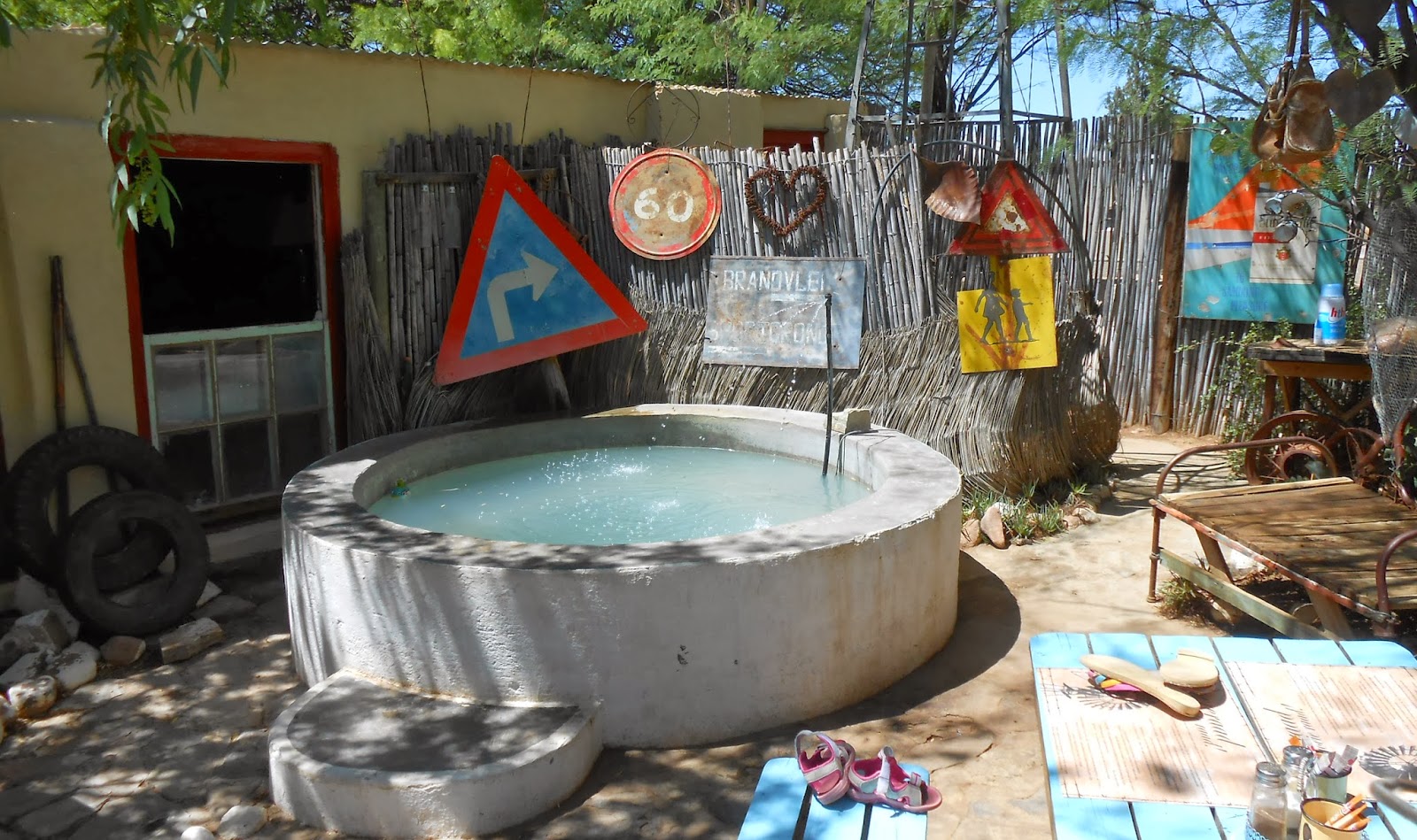
                                                               Karoo jacuzzi, Williston


The dirt roads in the Kgalagadi Transfrontier Nat Park and in Namibia
are generally great.                   Wow!,. its hot.
Only once you've felt the 'real heat' here do you have true respect
for the region and the people who survive there.
The swimming pools in most of campsites, saved us.


Around the world in Rocky Sandals. Travel kit #10


I bought my first pair of Rocky Sandals in South Africa, 1992
They've lasted over 20 years and have walked with them in over 25 countries.

1st pair on the left, now finished.   The new pair (right)  R360.00  in 2013


They may be called 'Aqua sandals' and I used them in mud, water etc.
Great for hiking. Very light and they dry quick.


14 July 2013

Mystical Ireland

Summer in the Republic of Ireland, June 2013


                       Photo: Tralee Bay area

A small country with a very long history.
I think one could virtually drive around the whole of Ireland
with only 1 tank of fuel.
At first, we got 'lost' in Dublin, then drove across Ireland and
spent time in the 'Ring of Kerry' area and then went along the South
and East coast.
Camping in Ireland can be tough, but we did it.
I was pleasantly surprised - campsites everywhere,
very organized and safe. It's hard to believe, Ireland even has
'beautiful white sandy beaches' with surfers.. yes, its true.


                                     Photo: A pub in Dingle

01 April 2013

Be prepared. Every traveller should have..... Kit ideas No.#9


"The better prepared you are, the more enjoyable your trip."


Every traveller should have a small First Aid Kit and a small Sewing kit.
That said, I've meet many young guys who can't sew a simple button on a shirt.


No picture of a sewing kit with a small pair of scissors.
WHY?   They get confiscated at most airports by airport security.

(Airports around the world have 'tons' of confiscated scissors /Swiss Army knives.)

NB: Check what you are allowed to carry on you, in your carry-on bag and
in your check-in bag when flying.


It's important to have your own small First Aid kit.
Tip:- Don't buy a first aid kit. Make one-up one your own.


-Every car owner should have jumper cables and a strong tow rope in their car. 
 Most people don't.

I respect the 'Preppers and Survivalists', laugh at them if you will, but they are
organised and have half a plan, which is more than most of us can say.

How many of us have a 'Bug out bag' or a '72hr emergency kit' in your home?
This is the ONE bag you grab when there is a fire/emergency etc.

International Red Cross, Fact 2013In disaster situations world wide,
it takes an ave of 72 hours before a rescue team can get to you.

Check-out sites like 'Bug out' and 'SHTF.'


To 'check-in' your luggage or not? Kit idea No. #8

I'm looking into the idea of flying with 'carry-on' luggage
only and not having any 'check-in' luggage at all.
Please note that rules and laws do change.

For carry-on luggage on international long distance flights
you are allowed to also have a laptop bag and a hand bag with you.
Check out a site called www.onebag.com, for some good ideas.


The best size carry-on backpack would be about 45liters or less.
Any larger and it will not comply with the 'carry-on' measurements


Though it is true that stuff from your 'carry-on' luggage is also
 stolen, in the airport, at security or even during the flight.

FACT: A report from leading air carriers shows that:-
- An ave of 1 in 3 passengers on every flight will have
  their 'check-in bags' lost, pilfered or damaged.

There are some problems with having only 'carry-on' luggage.
- Every airline has different 'carry-on' rules.
- Each airport has a different set of security rules.

Prohibited items you may not take in your 'carry-on' bag: -
-NO bottles of water
-No gel-insoles in your shoes
-NO matches, nail file, multi-tool, scissors
-NO small pocket knife, pliers, tools or screwdrivers
-NO liquids or gels or toothpaste over 100ml
  all liquids/gels must be stored in clear 100ml containers,
  kept in a 'clear zip plastic bag' and then security checked at customs.
(You are responsible to make sure you have the clear zip bag.)

-You are allowed to carry large sewing/knitting needles. (Weird...)
-Oh, you may carry your own spoon and fork.

16 January 2013

Colourful Portugal

The wonderful sights and colours of Portugal.


I believe that Portugal has more castles and
restaurants than any other country in the world.


The medieval streets of Obidos


Obidos


27 December 2012

Go off the main track and discover some 'secret places'. South Africa.


The Northern Cape.
South Africa's largest, undiscovered and untouched Province.
-Totally overlooked by the local and international tourist.

The Northern Cape, the 'real secret' province.

Some highlights include:-

1. Visit the diamond town of Alexander Bay.
2. See the 300.000 plus seal colony, at Kleinzee.
3. See the worlds largest desert floral garden. (July and Sept)
4. The Windmill Museum, at Loeriesfontein.
5. Riemvasmaak hot springs, next to Augrabies Falls Nat park.
6. Verneuk Salt Pan, near Brandvlei.
7. Kalagadi Nat Park, one of South Africa's best self-drive, safari parks.
8. Lamberts Bay, The crayfish capital and famous bird colony.
9. The Richtersveld Nat Park, South Africa's most remote Park.


The famous Quiver Tree forest


Karoo Jacuzzi, Williston.


The Northern Cape is a photographers dream.

Most tourists only drive up and down along South Africa's Southern
and Eastern coastline.
They totally miss the West Coast and our real desert areas
in the true heart of the country.
The people who survive in these parts are extra tough.
Try visit the town of Hotazel, comes from the name 'Hot as Hell'.


Not a UFO. A social weavers nest.


The worlds largest post box, Calvinia